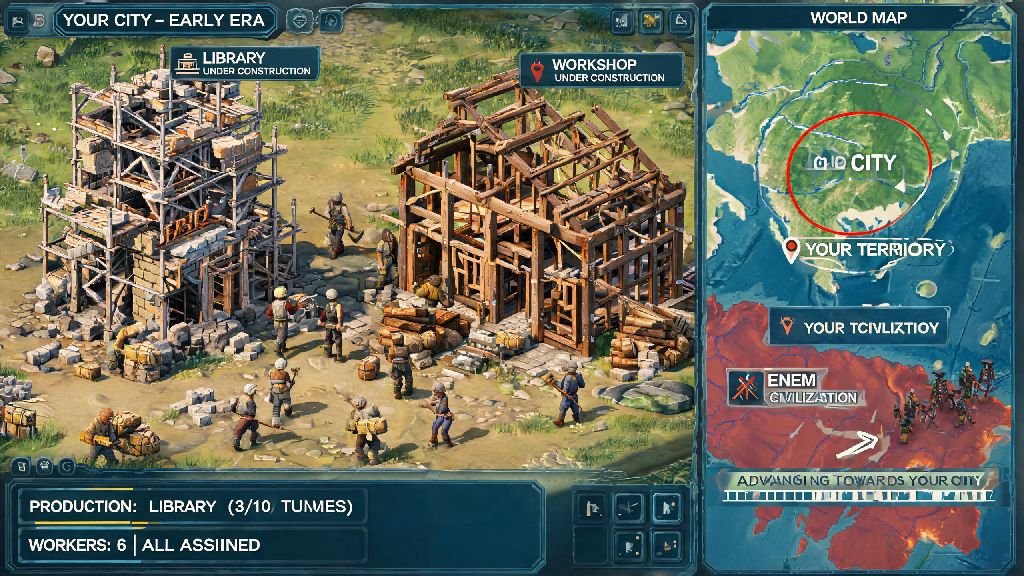
I still remember my first Civ game: I spent 3 hours building nothing but libraries, got invaded by a neighboring civilization on turn 72, and quit before I even unlocked the industrial era. If you’re feeling overwhelmed by all the moving parts of the iconic 4X franchise’s latest entry, you’re not alone. Civilization 7 for beginners can feel like learning to steer a ship while you’re still building the hull, but you don’t need to memorize every unit or tech tree to have fun and win your first game. This guide breaks down the most important rules you need to know, no 100-hour playtime required.
First Rule for Civilization 7 for Beginners: Prioritize Production Above All Else
If you’re coming from other 4X games, the production priority might feel counterintuitive, but it’s the most consistent piece of advice I give every new player asking about Civilization 7 for beginners. Production is the measure of how fast your city can build anything, from units to buildings to world wonders. Even if you have tons of gold to buy buildings, you’ll run out of gold fast if you’re not generating enough production to cover most of your builds.
That means you should always assign your citizens to tiles with the highest production first, even if it means your population grows a little slower. A city that produces 10 units per turn can build a warrior in one turn, while a city that produces 2 units per turn takes five turns to build the same unit. That difference adds up fast, and by turn 100, you’ll be miles ahead of players who prioritize food or gold above all else.
Your first two builds in every new city should always be a builder first, then a granary unless you have a very specific early-game plan. The builder lets you improve production tiles to get even more output, and the granary boosts your food just enough to grow your population steadily without sacrificing build speed.
Pick a Clear Win Condition Before Turn 50
A lot of new players try to do everything at once, and that’s the fastest way to lose. You have four main win conditions to choose from, and you don’t need to engage with all of them. Picking one early lets you focus your production and research on only the things that help you reach that goal, so you don’t waste turns building irrelevant structures.
For your first playthrough, I recommend picking either science or domination win. They’re the most straightforward, and you don’t have to juggle as many moving parts as you do with culture or diplomacy wins. You can pivot later if your plans get disrupted, but having a clear goal early eliminates a lot of the decision paralysis new players face.
Don’t Pick Fights You Can’t Win
I see so many new players declare war on the first neighbor they meet because they have two extra warriors, and that almost always backfires. First, check the military strength number in the top right corner of your screen before you declare anything. If your strength is 20% lower than the civ you want to attack, hold off. Also, pay attention to their alliances: if they’re allied with three other civs, declaring war on them means you’re fighting four opponents at once, which is a death sentence for new players.
Archers are the best early-game defensive unit by a mile, so build at least two per border city before you even think about expanding aggressively. If a neighbor declares war on you first, don’t panic: fortify your units on hill tiles to get a 30% defense bonus, and use your cities to shoot at invading units until your reinforcements arrive. You don’t need to conquer their entire empire to win a defensive war; just hold them off long enough for them to offer a peace deal that gives you extra gold or territory.
Another common mistake new players make is leaving their cities completely unguarded. Even if you’re playing a peaceful civ, you should have at least one military unit per city to fend off barbarian raids, which can destroy your builders and pillage your tiles if you’re not prepared. Barbarians spawn in unimproved tiles that are outside your city’s borders, so make sure you send scouts to explore the area around your cities early, and clear out barbarian camps as soon as you find them. If you leave a camp standing for too long, they’ll spawn more and more units, and eventually start attacking your cities directly.
Use City-States to Your Advantage
A lot of new players ignore city-states completely, but they’re one of the most powerful tools in the game for new players. Each city-state gives you a bonus just for being their friend, and if you become their suzerain (have more envoys sent than any other player), you get a unique bonus that can push your win condition forward way faster. For example, a scientific city-state will give you extra science output for all your cities if you’re their suzerain, which can cut dozens of turns off your science win timeline.
Envoys are earned automatically as you progress through the civic and tech trees, so you don’t have to do anything special to get them. You can also earn extra envoys by completing city-state quests, like building a specific type of unit or improving a certain resource within your borders. These quests are usually super easy to complete, and the extra envoy you get is well worth the small effort. Always send your first free envoy to a city-state that aligns with your win condition as soon as you meet them.
You don’t need to conquer city-states; the bonuses you get from being their suzerain are way more valuable than the extra city you’d get from taking them over, and you won’t anger other civs that are also friends with that city-state. Just make sure you check if another civ is already competing for suzerainty before you dump all your envoys in one place. Don’t waste envoys on city-states that don’t align with your win condition; if you’re going for a domination win, a cultural city-state that gives you extra art slots is almost useless, so save your envoys for military city-states that give your units extra combat strength.
At the end of the day, Civ 7 is meant to be fun, not a test you have to pass on the first try. It’s okay to make mistakes, restart games when things go completely off the rails, or lower the difficulty if you’re still getting the hang of the mechanics. Civilization 7 for beginners doesn’t have to be overwhelming if you stick to the core tips we covered, focus on your chosen win condition, and don’t bite off more than you can chew in your first few playthroughs. Next time you boot up the game, pick a simple civ like Rome (they get extra production for all buildings, perfect for new players) and try out these tips for yourself. You’ll be winning on Prince difficulty before you know it.