If you’ve ever booted up a Civ game and immediately panicked when the difficulty menu popped up, you’re not alone. I’ve lost more early-game saves than I can count picking a difficulty too high for my rusty strategy skills, and I’ve also fallen asleep halfway through a playthrough when the challenge was too low. Understanding the Civilization 7 difficulty levels is the first step to making every playthrough feel rewarding, no matter if you’re picking up the franchise for the first time or you’ve been chasing Deity wins since Civ 3. In this guide, I’m breaking down each tier, what changes between them, and how to pick the right one for your next run.
What Changes Across Civilization 7 Difficulty Levels?
Many new players assume difficulty only makes the AI better at fighting, but that’s a common misconception. Firaxis has tweaked the difficulty system over decades of Civ releases, and the Civ 7 system touches almost every part of the core loop. The AI production bonuses mean higher-tier AI can build units and districts faster than you even if they have worse tiles to work with. Player starting penalties on the highest difficulties mean you’ll start with less food and gold than the AI, so you can’t afford to waste turns building non-essential structures early on.
Diplomacy bias shifts too: on lower difficulties, AI will give you better trade deals and are less likely to hold grudges if you take a tile they wanted. On higher difficulties, they will remember even small slights for hundreds of turns, and will team up with other AI to take you down if you get too powerful. Barbarian spawn rate also goes up with difficulty, so you can’t leave your borders unpatrolled if you don’t want to lose a settler to a random raiding party. Victory condition threshold adjustments are another hidden change: on higher difficulties, you’ll need more tourism for a culture win, more techs for a science win, and more faith for a religion win, while the AI needs less to hit those same targets.
Breakdown of Every Difficulty Tier From Easiest to Hardest
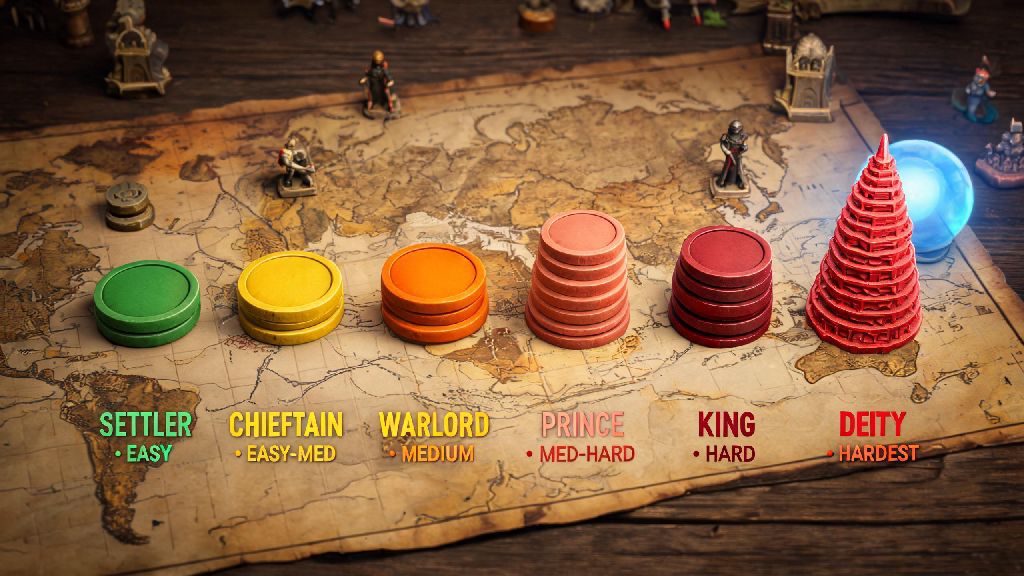
There are 8 total difficulty tiers in Civ 7, ranging from totally casual to brutally challenging. Here’s a quick overview of each:
Let’s dive a little deeper into what you can expect from each. If you’ve never played a Civ game before, Settler is the perfect starting point. You get 50% extra food and production on all tiles, barbarians will only attack if you walk directly into their camps, and AI civs will almost never declare war on you unprovoked. You can take your time learning how districts work, how to manage your amenities, and how different victory conditions work without any pressure. Chieftain is the next step up, for players who have the basics down but don’t want to stress about min-maxing. Your bonus drops to 20%, barbarians will raid unprotected tiles, and AI will declare war if you settle too close to their borders or steal their wonders, but they’re still pretty forgiving.
Warlord is the first tier where the AI gets a small 5% production bonus, so you’ll notice they start completing wonders and expanding faster than you if you slack off. Prince is the baseline balanced tier, no bonuses for you or the AI. I always tell new players to aim to get to Prince as soon as they’re comfortable, because any strategies you learn on Prince will work on all higher difficulties, while strategies that rely on your lower-difficulty bonuses will fail when you move up. King is where the real challenge starts for most casual players. AI gets a 10% food and production bonus, they’re far more aggressive about expanding and competing for great people, and barbarians spawn 15% more often. If you can win consistently on King, you have a solid grasp of Civ 7 mechanics.
Emperor is for players who want a real test. AI gets 25% bonuses, they will actively block you from settling good land, they will snipe wonders you’ve been building for 10 turns, and they will declare war on you if they see you have a small military even if you’ve been trading with them for centuries. Immortal is the second-hardest tier, with 40% AI bonuses. The AI starts with an extra warrior and builder, so they will expand much faster than you in the early game, and you’ll need to optimize every single turn to keep up. Deity is the hardest possible tier, reserved for veteran players who have mastered every part of the game. The AI gets 60% food and production bonuses, starts with two extra settlers, a warrior, and a builder, and will actively work to sabotage any victory path you’re pursuing. I’ve only won two Deity runs in my time playing Civ 7, and both took me over 10 hours of careful planning and more than a few reloads to pull off.
How to Pick the Right Difficulty for Your Playthrough
There’s no shame in playing on a lower difficulty if you’re just here to have fun. I usually play on Emperor, but if I’m trying out a new custom civilization or a silly strategy like a one-city religion win, I drop down to King so I can mess around without worrying about getting wiped by an AI surprise war. The right difficulty for you will always depend on what you want out of your play session. If you’ve had a long week and just want to build a pretty, sprawling empire without stress, Chieftain or Warlord is perfect. If you want to test a new strategy and feel a little challenged, stick to your usual tier. If you’re bored of winning every run easily, move up a tier.
If you’re playing with friends in multiplayer, always poll the group before picking a difficulty. It’s not fun for new players if you pick Immortal and they get steamrolled by the AI in the first 50 turns, and it’s not fun for veteran players if you pick Settler and the game is too easy to be engaging. Most groups find Prince or King is the sweet spot that works for everyone. Also, don’t be afraid to adjust mid-run if you’re not having fun. If you started on King and you’re way ahead of every AI by turn 100, you can bump up the difficulty in the settings menu to make the rest of the run more challenging. If you started on Emperor and the AI is wiping the floor with you, you can drop it down a tier instead of restarting the whole run.
Tips to Adjust to a Higher Difficulty Tier
Moving up a difficulty tier for the first time can feel overwhelming, but small adjustments will make the transition much smoother. If you’re moving up from Prince to King for the first time, the biggest adjustment you’ll need to make is prioritizing expansion. On Prince, you can get away with building 3 or 4 cities and still win, but on King and above, you need at least 6 to 8 cities by turn 100 to keep up with the AI’s production bonuses. Spamming settlers early might feel like it’s slowing down your tech or culture progress at first, but the extra production and food from those cities will pay off massively in the mid-game.
Another tip is to avoid building wonders early unless they give you a massive, immediate bonus. The Pyramids are great, but if you spend 30 turns building them on Emperor, the AI will have already settled all the good land around you while you’re working on it. Save the wonders for the mid-game when you have a solid economy to support the build time. Also, make sure you always have at least one military unit per two cities you own on higher difficulties. That’s enough to deter most AI from declaring war on you, and enough to fend off barbarian raiders before they can steal your settlers or destroy your improvements. I learned this the hard way on my first Emperor run, where I focused entirely on science and had no military, and a nearby warmonger civ declared war on me in turn 70 and took all my cities before I could even build a single warrior.
Finally, be flexible with your victory condition. If you planned for a science win but an AI is already 10 techs ahead of you by turn 150, pivot to a culture or domination win instead of banging your head against a wall. Higher difficulty runs often require you to adapt to what the game gives you, instead of sticking rigidly to a plan you made before you even spawned on the map.
At the end of the day, the best part of Civ 7 is that you can tailor the experience to exactly what you want out of it. You don’t have to prove anything to anyone by playing on the highest possible tier if you’re not having fun. Taking the time to learn the ins and outs of the Civilization 7 difficulty levels will help you pick the perfect challenge for every run, whether you want a casual city-building session or a cutthroat test of your strategy skills. Next time you boot up the game, don’t just stick to the difficulty you’ve always used – try moving up a tier, or drop down to mess around with a silly strategy, you might be surprised how much fun you have.