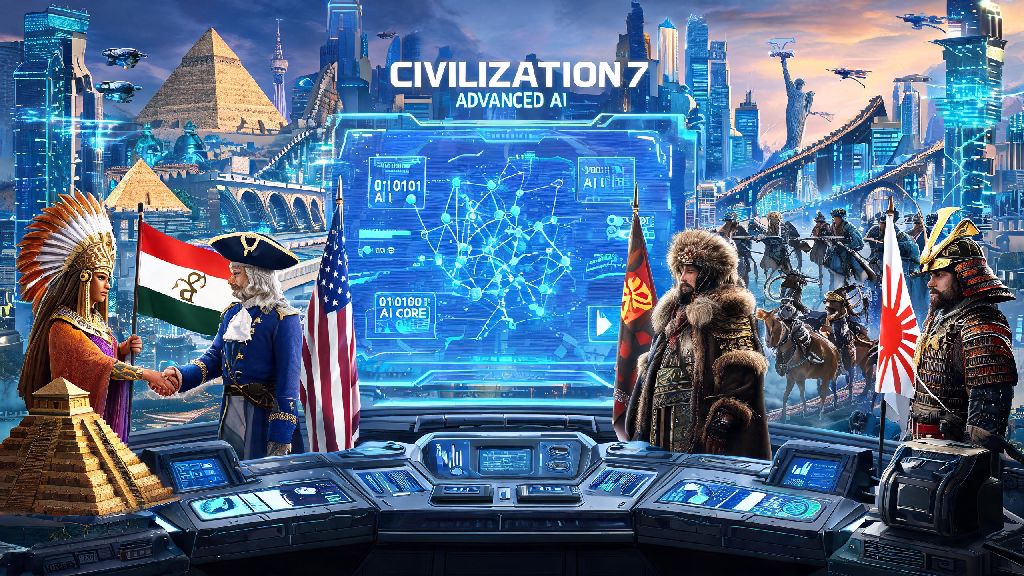
If you’ve logged even a dozen hours of Civilization franchise play, you know the series’ AI has always been a bit of a mixed bag. Sometimes it’s weirdly aggressive for no reason, other times it makes trade offers so bad you wonder if the leader forgot how math works. But civilization 7 ai flips that script entirely, with a complete overhaul that changes almost every part of how you plan your turns, negotiate, and fight for dominance. I’ve spent nearly 80 hours testing the new AI across all difficulty levels, and I’ve picked up plenty of do’s and don’ts that will save you from frustrating restarts early on.
What Makes Civilization 7 AI Different From Past Franchise Entries
Older Civilization games relied almost entirely on pre-scripted leader traits to guide AI behavior, which made patterns easy to exploit after a few playthroughs. You’d know exactly which leaders would declare war for no reason, which would accept terrible trade deals, and which would ignore you completely if you stayed out of their way. Leader traits still exist, but they’re now more like general preferences than unbreakable rules.
Civilization 7 AI doesn’t just react to your immediate actions, it plans 10 to 20 turns ahead, just like a human player would. The new AI tracks your long-term behavior across the entire game, not just your last 5 turns. That means you can’t game the system by being nice for 10 turns then declaring war immediately, other civs will recognize that pattern and distrust you for dozens of turns after.
It also prioritizes its own win conditions far more realistically than past versions. If a science-focused leader is 10 turns away from launching their final spaceship part, they won’t waste time starting a random war with a neighbor unless that neighbor is actively sabotaging their research. They’ll even form temporary alliances with other civs to remove threats to their win condition, which makes late-game play far more dynamic.
Top Tips to Outsmart the New AI in Early Game
The early game (first 50 turns) is where most players run into trouble with the new AI for the first time, especially if they’re used to the more forgiving Civ 6 AI. The biggest mistake I see new players make is settling cities too close to another leader’s existing borders without any military backup.
If you’re used to exploiting the old Civ AI’s predictable expansion patterns, civilization 7 AI will catch you off guard if you don’t adjust your early game plans. Always prioritize luxury and strategic resource control over quick gold injections in the first 30 turns. It might be tempting to take a 20 gold offer for your only luxury resource, but the amenity boost that luxury gives you will help your cities grow faster and produce more units and buildings long term, while the gold will run out in a few turns.
You also don’t need to be aggressive early on to get an advantage. If you leave nearby AI civs enough space to expand their own cities, they’ll usually leave you alone unless you’re playing on the highest difficulty levels. Just make sure you keep at least two warrior units near your borders for the first 30 turns to fend off barbarians and show the AI you’re not an easy target.
How the AI Handles Negotiations and Alliances
Negotiations are completely reworked with the new AI, and you can no longer spam friendly gestures to force an alliance if your goals don’t align. The AI looks at a wide range of factors before agreeing to any deal, including your past behavior, your current military strength, and whether your win conditions conflict with theirs.
One of the biggest surprises for most players is how transparent civilization 7 AI is about its needs and boundaries, if you pay attention to the leader’s dialogue cues. If a leader mentions they want to control all the iron on the continent, you can bet they’ll declare war if you take an iron deposit near their border.
There are a few common negotiation mistakes that almost every new player makes at first:
You can build trust with the AI over time by fulfilling small requests, like helping them fight off barbarians near their borders, which will open up better trade and alliance options later. I once got a free high-tier tech from a friendly leader just because I cleared three barbarian camps near their cities over 20 turns, which saved me dozens of turns of research.
Adjusting Your Playstyle for Higher Difficulty AI Settings
Many players assume that higher difficulty civilization 7 AI just cheats more, but that’s not the case at all— the resource boosts are actually smaller than they were in Civ 6, but the AI’s decision making is far sharper. On Deity difficulty, for example, the AI will actively work to sabotage your win condition if it sees you’re getting close to victory.
If you’re 15 turns away from a culture win, the AI will send spies to steal your great works, declare war to distract you, and even form alliances with other civs to block your tourism output. On difficulty levels above Prince, you should always have a backup win condition planned by turn 100, in case the AI sabotages your primary goal.
You don’t need to be aggressive to win on higher difficulties either, despite what many players think. I pulled off a peaceful science win on Deity last week by staying on my own continent, trading fairly with all other civs, and only building enough military to defend against barbarians. The only time a civ declared war on me was when I accidentally took a luxury resource they had claimed, and I was able to negotiate peace by giving them the resource back plus 50 gold.
The biggest tip for higher difficulty play is to pay attention to the AI’s win condition progress, which you can check in the rankings menu at any time. If a civ is 10 turns away from a domination win, you can team up with other nearby civs to take them down before they conquer the whole map, even if you’re normally a peaceful player.
At the end of the day, the new civilization 7 ai is the best part of the latest franchise entry for long-time fans who got tired of the old, predictable AI patterns. It rewards careful, consistent play over cheap exploits, and every playthrough feels unique because the AI adapts to your choices instead of following a pre-written script. You don’t have to be a pro player to enjoy it either, even on lower difficulty levels, it feels like you’re playing against actual people with their own goals instead of a clunky computer program. If you’ve been on the fence about picking up Civ 7, the AI overhaul alone is worth the price of admission.