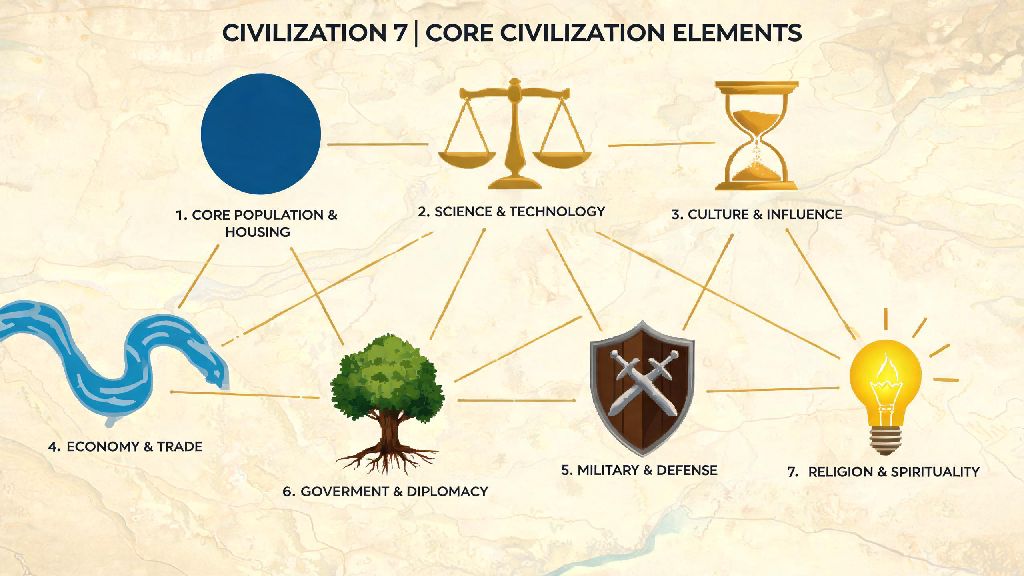
If you’ve spent any time grinding Civilization 7 matches in 2026, you’ve probably noticed that random, unplanned builds rarely get you past Prince difficulty without a ton of luck. The difference between consistent winners and players who get steamrolled by AI or multiplayer opponents almost always comes down to how well they prioritize the 7 elements of a civilization across every era. I’ve put 120+ hours into the 2026 base game and two post-launch patches, so I’ve broken down exactly what each element does, how to balance them, and common mistakes to avoid if you want to hit Deity rank this year.
Breaking Down the 7 Elements of a Civilization for Civ 7 2026
You don’t have to master every element equally to win a match, but you do need to understand what each one contributes so you don’t leave critical gaps in your civ’s development. The core seven elements, ranked by baseline priority for all playstyles, are:
A lot of new players make the mistake of only focusing on one or two of these elements, like rushing tech exclusively for a science win, but that leaves you massively vulnerable. I once had a multiplayer opponent who was 2 eras ahead of everyone in tech, but had zero military, so my 10 crossbowmen took all 6 of his cities in 10 turns before he could unlock gunpowder units. Balance, even for focused win conditions, is non-negotiable.
How to Balance These Elements Across Early, Mid, and Late Eras
The ideal balance of the seven elements shifts dramatically depending on what era you’re in, so you can’t stick to a single priority list for the entire run. In the early era (Ancient to Classical), your top two priorities are almost always population/housing and resource infrastructure. You don’t need a huge military early unless you spawn next to a known aggressive leader like Genghis Khan or Alexander, but you should aim to get your first 3 cities up and running within the first 50 turns, each with at least +2 housing to avoid growth stagnation.
When you hit the mid era (Medieval to Industrial), balance gets far trickier. AI civs on Deity difficulty will start declaring surprise wars if they see you have less than half their military strength, even if you have a declared friendship. Spend at least 15% of your production on military units in the mid era even if you’re going for a peaceful win to avoid being caught off guard. This is also the point where you should start investing in cultural buildings to keep loyalty high as you expand to new continents.
In the late era (Modern to Future), you can lean more heavily into the elements aligned with your win condition, but you still can’t neglect the others. If you’re going for a culture win, for example, you still need a small defensive force and solid gold income to upgrade tourism buildings as needed. If you want to see exactly how these element weights were adjusted in the latest patch, you can reference the official 2026 Civilization 7 balance update notes for a full breakdown of yield changes per era.
Common Mistakes That Throw Off Element Balance
Even players with hundreds of hours in older Civ titles fall into the same traps when playing the 2026 version of the game, since the balance is far more focused on cross-element synergy than previous entries. The most common mistake is overprioritizing one element to the complete neglect of others. I once made this exact mistake in a Deity run last month, where I skipped building military to finish the Great Library, only to have Genghis Khan roll in with 6 horse archers and take my capital before I could build a single spearman.
Another frequent mistake is failing to adjust element priorities when your situation changes. If a neighboring civ suddenly declares a surprise war, you need to shift almost all your production to military immediately, even if you were halfway through building a world wonder. Pushing through that wonder instead of building units will almost always lead to you losing multiple cities, or even the entire match. That lost wonder production is nothing compared to the loss of an entire city’s output.
Finally, a lot of new players ignore luxury resources because they think they only provide minor happiness bonuses. In 2026’s Civ 7, luxury resources directly boost population growth and loyalty by 20% per unique resource, which is core to scaling every other element. Skipping out on claiming a nearby luxury resource just because it doesn’t have high production or food yields is a mistake that will slow your entire run down by 10 to 20 turns.
Tailoring Element Priorities to Your Win Condition
While you can’t ignore any of the 7 elements, you can shift how much you invest in each based on what win condition you’re chasing, which lets you play to your preferred playstyle without throwing games. For a science win, you’ll obviously prioritize technological research speed first, but you still need solid economic stability to fund research labs and space port projects, and enough military to defend your space ports from raiders in the late game.
For a culture win, cultural and ideological identity is your top priority, but you need strong trade routes to spread tourism to other civs, and enough diplomatic standing to avoid being sanctioned by the global council, which can cut your tourism output in half. For a domination win, military and defensive capacity is number one, but you need enough technological research to unlock late-game units like tanks and drones, and enough economic stability to afford constant unit upgrades.
If you’re playing for a diplomatic win, governance and diplomatic standing is your core focus, but you need enough resource infrastructure to donate to global disaster relief efforts, and enough cultural output to get your policy proposals supported by other civs. You can always adjust your win condition mid-game if one element is way stronger than you expected – for example, if you have way more tourism output than research by the Atomic era, you can switch from a science win to a culture win without restarting your run. That flexibility is one of the best parts of Civ 7's 2026 design, and it’s something a lot of players miss by locking themselves into a single playstyle from turn one.
At the end of the day, every great Civ 7 run boils down to intentional, balanced management of the 7 elements of a civilization. You don't have to be perfect to win, but avoiding the common mistakes of overprioritizing one area and adjusting your strategy as the game progresses will help you win far more matches than you lose. Try testing different balance levels in your next few unranked runs to see what works best for your playstyle, and you'll be hitting Deity wins before you know it.