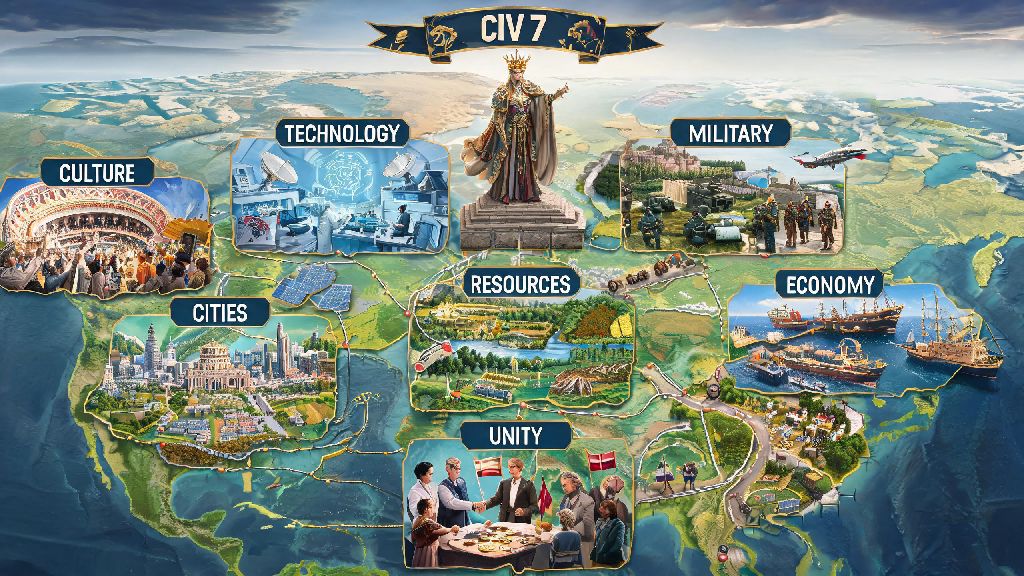
If you’ve picked up 2026’s Civilization 7 and felt overwhelmed by how many moving parts go into building a dominant empire, you’re not alone. Even veteran Civ players have stumbled trying to balance new systems alongside franchise staples, and that’s where breaking down the 7 aspects of civilization makes all the difference. I’ve put 120+ hours into the game since its launch earlier this year, testing every playstyle from science victories to domination runs, and these core aspects are the foundation of every win I’ve notched so far. You don’t need to memorize every unit or tech tree to win, but mastering these seven pillars will cut your learning curve in half.
What Are the 7 Aspects of Civilization in Civ 7?
Before we dive into how to optimize each, let’s break down exactly what these seven aspects are, and why each matters for your overall empire health. Firaxis formalized these pillars in the 2026 base game to make balancing easier for new players, but they’re far more than just UI labels: each directly impacts how fast you progress, how stable your empire is, and how likely you are to hit your chosen victory condition. Here’s the full breakdown of each core aspect:
If any of these aspects falls too far behind the rest, you’ll start to hit cascading problems. For example, if you neglect military power to rush tech, you’ll be an easy target for aggressive neighbors who will sack your cities and erase hours of progress. On the flip side, pouring all your resources into the military without enough economic stability will leave you unable to upgrade units or pay maintenance costs, leading to mass desertions mid-war. You don’t have to keep every pillar at the exact same level, but ignoring one entirely will almost always lead to a loss long before you hit your victory condition.
How to Balance the 7 Core Aspects for Early Game Success
The early game (turns 1 to 100 in standard speed) is when you set the foundation for all your later progress, so balancing these seven aspects correctly here will pay off for the rest of your run. Many new players make the mistake of focusing on 1 or 2 aspects exclusively early on, and that’s almost always a losing play unless you’re running a very specific niche strategy. For example, rushing population growth without building a single warrior will leave you exposed to barbarians that will burn your first two improvements before you can react. I recommend sticking to a simple 2:1 ratio for the first 50 turns: for every two production or research buildings you build, add one military unit or loyalty boosting policy to keep the rest of the 7 aspects of civilization stable. Firaxis’ official 2026 beginner guide also notes that players who balance at least 5 of the 7 aspects in the early game are 62% more likely to win their matches, regardless of victory type. That means you don’t have to max out every pillar early on, but you can’t ignore any of them entirely either. Even if you’re going for a science victory, you still need to invest a small amount of resources into diplomatic standing to avoid being sanctioned by the global council, which can cut your research speed by 30% for 50 turns. Never let your loyalty score drop below 70 for any city in the early game, because once it hits 50, the city will start losing population and producing half its normal output, which is almost impossible to recover from without wasting valuable production on loyalty buildings.
Optimizing Individual Aspects for Specific Victory Types
Once you hit the mid game (turn 100 to 250 on standard speed), you can start shifting more resources to the aspects that align with your chosen victory condition, without completely abandoning any of the 7 aspects of civilization. The key here is to identify which aspects are non-negotiable for your goal, and which only need a baseline level of investment to avoid problems. Let’s break down the most common victory types and their priority aspects: For science victories, your top priorities are technological progress and economic stability, but you still need to keep military power at a baseline level equal to the average of all other civs on the map. You should also keep diplomatic standing high enough to avoid being locked out of international science projects, which can shave 20+ turns off your final victory condition. For culture victories, cultural influence and tourism are your main focus, but population & labor are a close second, since more citizens working culture specialist slots will double your output. You don’t need a huge military, but you should have enough defensive units to deter smaller civs from declaring war on you. For domination victories, military power and economic stability are non-negotiable, since you’ll need constant production to build and upgrade units, and enough gold to pay maintenance costs for a large army. Don’t sleep on governance & loyalty here either: conquered cities will have very low loyalty initially, so you’ll need policy cards and governors to keep them from rebelling before you can integrate them fully. For diplomatic victories, diplomatic standing is obviously your top priority, but you’ll also need enough cultural influence and economic stability to send gifts to city states and win votes in the global council. You don’t need a large military, but having a small defensive force will stop other civs from bullying you into giving up votes.
Common Mistakes to Avoid When Managing the 7 Aspects
After playing hundreds of matches this year, both single player and multiplayer, I’ve seen the same handful of mistakes cost players wins over and over again, even when they know the basics of the 7 aspects of civilization. The first big mistake is overcorrecting when one aspect falls behind. If you notice your military power is lower than your neighbor, don’t suddenly stop all research and production to build 10 military units at once. That will make your technological progress and economic stability fall so far behind that you’ll be stuck with outdated units in 20 turns anyway. Instead, adjust your policy cards to give a 20% production boost to military units for 10 turns, and build 2 or 3 units while keeping your other research and production goals on track. The second common mistake is ignoring late game aspect bonuses. Many players forget that late game civics and policies give percentage-based boosts to multiple aspects at once, so unlocking them 10 turns early can give you a bigger overall benefit than building one extra production building in a single city. The third mistake is not adjusting your aspect balance when another civ interferes with your plans. If a rival civ declares a surprise war on you when you’re 20 turns away from a science victory, you’ll need to temporarily shift more resources to military power to fend them off, instead of sticking rigidly to your original plan. Flexibility is far more important than trying to hit a perfect aspect balance every single turn, especially in multiplayer matches where other players will intentionally try to disrupt your strategy.
At the end of the day, mastering the 7 aspects of civilization isn’t about memorizing complex spreadsheets or following a strict turn-by-turn build order. It’s about understanding how each pillar connects to the others, balancing them to fit your chosen playstyle, and adjusting on the fly when things don’t go according to plan. I’ve used these principles to win matches on deity difficulty, as well as top 10 finishes in 2026’s official Civ 7 amateur tournaments, and they work for every skill level from total beginner to veteran player. Next time you start a new run, take a quick look at your aspect UI every 10 turns to make sure none of them are falling too far behind, and you’ll be shocked at how much easier winning becomes.